
About Which Vacuum Bag
Which Vacuum Bag exists to answer one specific question quickly and correctly: which bag reference fits my vacuum cleaner. Most searches for a vacuum bag end on a retailer's product page that assumes you already know the reference code, or on a generic listing that names dozens of vacuum models without confirming any of them.
How the catalogue is built
Every bag reference published on this site is traced to either the manufacturer's own documentation or a recognised distributor's product listing. Where we could not verify a reference with confidence, most notably parts of the older Vax range, we say so plainly rather than publish a guess. We would rather list a smaller catalogue that can be trusted than a larger one with entries that might be wrong.
| What we do | What we do not do |
|---|---|
| Trace every reference to an official or verifiable source | Invent or estimate a bag reference to fill a gap |
| State the exact fitment, capacity and material for each bag | Publish generic listings that name many models without confirming fit |
How this site is funded
Which Vacuum Bag earns a small commission when you buy a bag through one of the Amazon UK links on this site, at no extra cost to you. As an Amazon Associate, this site earns from qualifying purchases. Links are placed after the answer, not before it, and we do not run advertising banners or collect your details through a sign up form.
What the catalogue covers today
| Brand | References listed | Bag codes covered |
|---|---|---|
| Miele | 2 | Miele FJM, Miele GN |
| Hoover | 2 | Hoover H30, Hoover H64 |
| Numatic (Henry) | 2 | Numatic NVM-1CH, Numatic NVM-2BH |
| Bosch | 1 | Bosch/Siemens Type G |
| Siemens | 1 | Bosch/Siemens Type G |
| Electrolux | 2 | Electrolux/AEG GR200S, Electrolux/AEG s-bag Classic |
| AEG | 2 | Electrolux/AEG GR200S, Electrolux/AEG s-bag Classic |
| Vax | 1 | Vax 6131 / 6131SX series paper bag |
| Panasonic | 1 | Panasonic C-20E |
| Karcher | 2 | Karcher WD2/WD3 fleece filter bag, Karcher fleece filter bag, part number 2.863-006.0 |
The catalogue grows from the requests we receive: a machine that is missing gets researched, and it is published once a manufacturer or distributor source confirms the bag code.
Capacity is not the fitting test
Capacity tells you how often you will change the bag, not whether it fits. Fit is decided by the collar: its shape, the size of its hole and the way it clips into the machine. The stated capacities below are published for reference, not as a compatibility check.
| Brand | Bag code | Stated capacity |
|---|---|---|
| Bosch | Bosch/Siemens Type G | 4 litres |
| Electrolux | Electrolux/AEG GR200S | 3.5 litres |
| Electrolux | Electrolux/AEG s-bag Classic | 3 litres |
| Hoover | Hoover H30 | 3.5 litres |
| Hoover | Hoover H64 | 3 litres |
| Karcher | Karcher WD2/WD3 fleece filter bag | sized to the tank |
| Karcher | Karcher fleece filter bag, part number 2.863-006.0 | sized to the tank |
| Miele | Miele FJM | 3.5 litres |
| Miele | Miele GN | 4.5 litres |
| Numatic | Numatic NVM-1CH | 9 litres |
| Numatic | Numatic NVM-2BH | 15 litres |
| Panasonic | Panasonic C-20E | 2.5 litres |
| Vax | Vax 6131 / 6131SX series paper bag | Approximately 3 litres |
Procedure for checking a vacuum bag when the model label is unclear
Start with the machine, not the old bag. Unplug the vacuum, open the bag chamber and look for the rating label on the base, rear cover, underside of the handle recess or inside the bag door. Write down the brand, model name and every number on the label. A useful model mark is often 5 to 12 characters long and may include a slash, a space or a suffix letter.
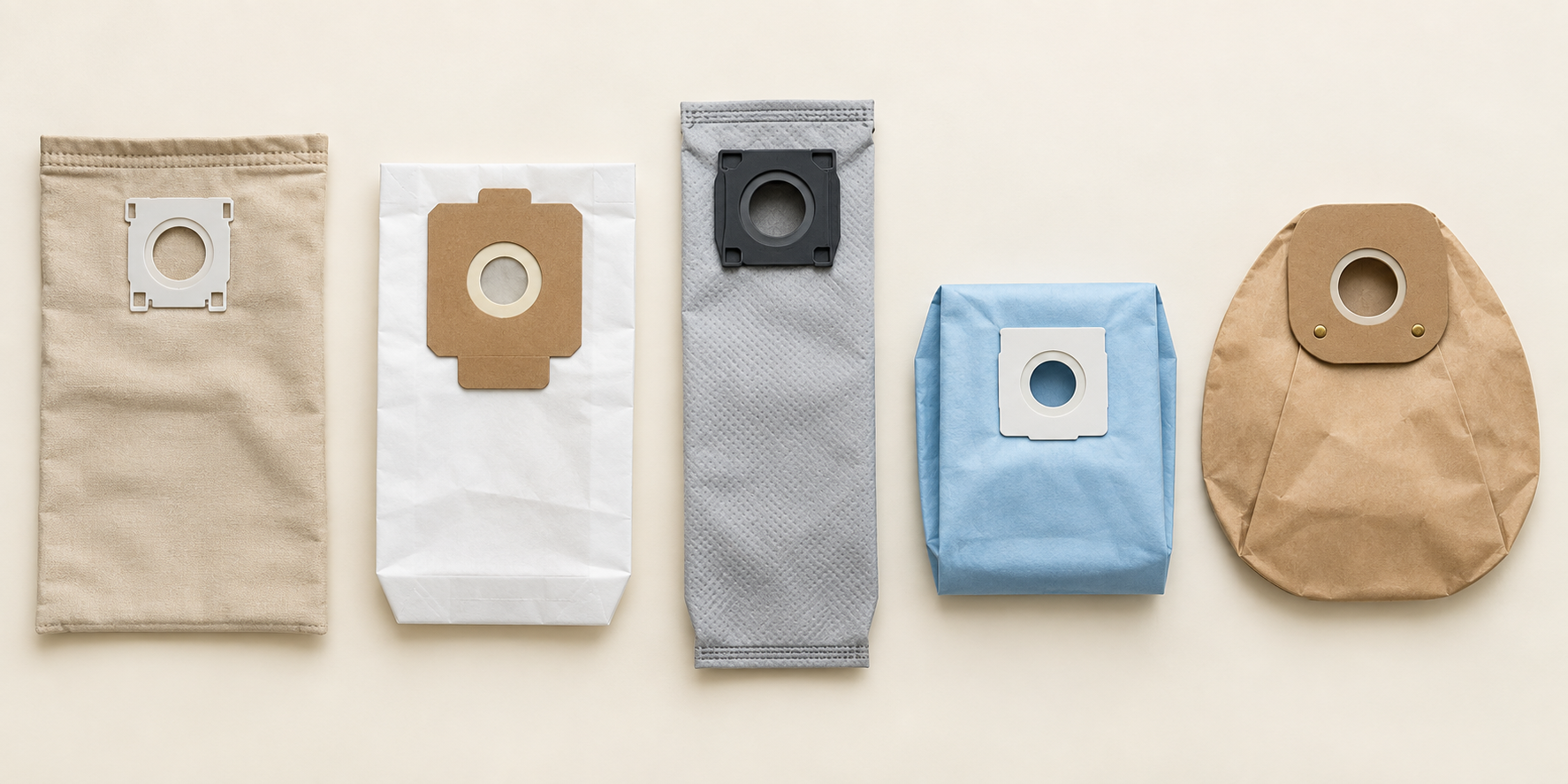
Next, check the bag holder. Remove the old bag by the cardboard or plastic collar, not by the paper or fleece body. If the collar tears, leave the torn part aside and inspect the plastic dock in the vacuum. The dock usually tells you more than the used bag because it shows the clip shape, the sealing face and the direction of insertion.
If the old bag is still intact, measure only the collar and the inlet hole. Do not measure the swollen dust compartment. Use a ruler with millimetres, place the collar flat on a table and record the outside width, outside height, inlet hole width and inlet hole height. Measure to the nearest 1 mm. A difference of 2 mm can matter on a rigid plastic collar, while a paper collar may compress slightly when locked into the holder.
Photograph the machine label, the empty bag dock and both sides of the old collar before throwing anything away. Use a square, front facing photo, not an angled one. A photo taken from 30 cm away in good light is usually clearer than a close photo where the phone lens distorts the shape.
Equipment and measurements worth taking
You do not need workshop tools. The aim is to collect enough physical evidence to avoid choosing a bag by appearance alone. A flexible tape is useful for the bag body, but a rigid ruler is better for the collar because it keeps the scale straight.
| Item | Use | Practical figure |
|---|---|---|
| Rigid ruler | Measures collar width, height and hole size. | Read to 1 mm. |
| Phone camera | Records label, dock and collar faces. | Take 3 photos before disposal. |
| Plain paper | Provides contrast behind a dark or dusty collar. | Use an A4 sheet. |
| Soft brush | Removes dust from the bag dock and label. | Brush for 10 to 20 seconds, do not wash electrical parts. |
| Small torch | Lights the inside of the bag compartment. | Check corners and the door side. |
For a paper or fleece bag, also note the approximate flat bag size. Lay it flat without stretching it, then measure the widest point and the longest point. This figure is secondary because the collar decides fit, but it helps to spot an obviously wrong item before opening a pack.
Keep dust out of the motor intake while checking. If the old bag has split, clean loose debris from the chamber with a second vacuum if available, or wipe the plastic surfaces with a dry cloth. Do not run the machine without a correctly fitted bag unless the manufacturer specifically designed that model for bagless use.
Frequent mistakes and how to recover
The most common mistake is reading a marketing name as the full model. A name printed on the lid may describe a range, while the exact version is on a rating label. If two machines share a name but use different bag docks, the lid name is not enough.
- If the old bag has no readable code, use the machine label and collar measurements rather than searching for the faded print.
- If the bag slides in but the door will not close, remove it and check the collar orientation. Forcing the door can bend the holder or break the seal.
- If dust appears behind the collar after a short run, stop after 30 seconds and inspect the seal. A small leak at the collar can put fine dust into the pre motor area.
- If the bag seems much smaller than the chamber, do not judge by volume alone. A small correct bag is safer than a large bag with the wrong collar.
- If a listing names many models but your exact suffix is missing, treat it as unconfirmed until the collar and model evidence match.
If you have already bought the wrong bag, do not trim the collar to make it fit. Cutting the hole larger or removing locking tabs usually weakens the seal and can allow dust past the bag. Instead, keep the unused bags clean, keep the packaging if you still have it and compare the wrong collar with the old collar before searching again.
When a machine has lost its label, the safest recovery route is to identify the bag dock. Note whether the holder accepts a sliding card, a hinged latch, a round push fit seal or a keyed plastic plate. Then compare that physical evidence with confirmed references. The FAQ explains what to send if you need a missing machine checked.
Special cases that need extra caution
Wet and dry vacuums need particular care because some use different collection methods depending on whether the task is dry dust, rubble or liquid. Never assume a paper dust bag is suitable for liquid pickup. If the job involved damp plaster, water or ash, empty and inspect the machine according to its own instructions before fitting any new bag.
Older machines are another special case. A surviving bag inside the vacuum may be a substitute fitted years ago, not the original reference. Age also affects paper collars. After 10 or 15 years in a cupboard, card can shrink, delaminate or tear around the inlet hole, so the old bag may no longer show its original size accurately.
Shared platforms also need care. Some brands used the same bag family across several ranges, while other machines with a similar body shape used a different dock. A visual match of the fabric or paper body is not enough. The collar, locking points and inlet seal must match together.
For commercial or heavily used machines, check the bag seat each time the bag is changed. A worn latch, cracked door or trapped cable can prevent a correct bag from sealing. A quick 1 minute inspection before fitting the bag is faster than cleaning dust from the motor area later. For general fitting questions, see the FAQ.
Read next
- OEM vs compatible vacuum bags: The practical difference between original manufacturer bags and compatible third-party bags, and when each makes sense.
- Where to find your vacuum's bag reference: The three places to check on your vacuum cleaner to find the exact bag reference or model number.
- What to do if your model is not listed: Steps to take if you cannot find your exact vacuum model in our catalogue, without guessing at a bag reference.